Table of contents
Are there trends in choosing package names in various programming ecosystems? Do package authors choose names for their packages that are alliterated with the name of the programming language? Let's venture to find out.
First let's install a couple of useful packages.
Code
using PkgPkg.activate(@__DIR__)# Pkg.add("Plots")# Pkg.add("StatsPlots")# Pkg.add("DataStructures")# Pkg.add("HTTP")# Pkg.add("JSON3")# Pkg.add("DataFrames")# Pkg.add("CSV")# Pkg.add("CodecZlib")# Pkg.add("Tar")We can "bucket" the package names by their starting letter and count the number of packages in each bucket, i.e. a frequency plot.
Code
using Plotsusing DataStructuresusing HTTPusing Markdown
function get_buckets(items)  buckets = DefaultDict(0)  items = strip.(items)  for item in items    buckets[lowercase(first(item))] += 1  end  total = sum(values(buckets))  for (k, v) in buckets    buckets[k] = v / total  end  (buckets, total)end
function frequency_plot((buckets, total); lang, kind="packages")  fig_size = (800, 600)  names = [k for k in sort(collect(keys(buckets)))]  colors = DefaultDict("grey")  percent = DefaultDict("")  starting_letter = first(lowercase(lang))  if kind == "packages"    colors[starting_letter] = "orange"    for (k, v) in buckets      p = round((buckets[k] - WORD_BUCKETS[k]) * 100, digits=1)      percent[k] = "\n($(sign(p) > 0 ? '+' : '-')$(p)%)"    end  end  ax = bar([buckets[n] for n in names], xticks=(1:length(names), names), fillcolor=[colors[n] for n in names], size=(1600, 1000), legend=false, yaxis=false)  annotate!(1:length(names), [buckets[n] + (1 / (kind == "packages" ? 350 : 500)) for n in names], [("$(round(buckets[n] * 100, digits=1))%$(percent[n])", 8) for n in names])  title!("Frequency of $kind in $lang (Total: $total)")
  summary = if kind == "packages"    """    The difference in percent of names of $lang packages starting with "$starting_letter" and words in the English language starting with "$starting_letter" is $(replace(strip(percent[starting_letter]), ")" => "", "(" => "")).    """  else    ""  end  (ax, summary)end
nothing
:::div{.cell-output .cell-output-display} [ Info: Precompiling IJuliaExt [2f4121a4-3b3a-5ce6-9c5e-1f2673ce168a] ::: ::::
English
For a reference case, let's plot the distribution of words in the English
language, per the list in /usr/share/dict/words on my MacOS 12.5.
Code
words = open("/usr/share/dict/words") do f readlines(f)endWORD_BUCKETS, WORD_TOTAL = get_buckets(words)ax, summary = frequency_plot((WORD_BUCKETS, WORD_TOTAL), lang="/usr/share/dict/words", kind="words")display(ax)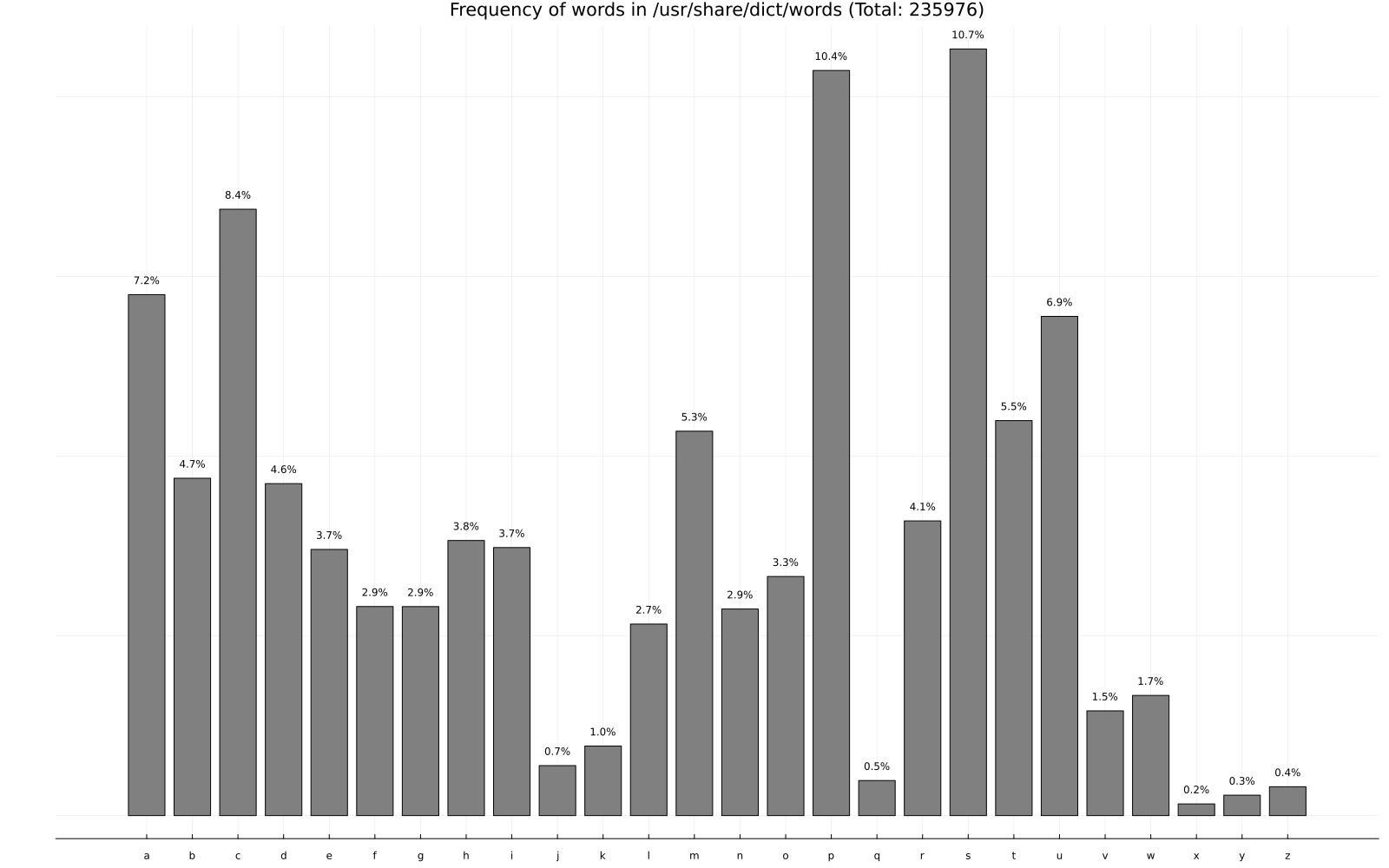 ::: ::::
Python
For Python, we can get the list of packages on PyPi using https://pypi.org/simple and get the names of all packages from the links.
Code
r = HTTP.get("https://pypi.org/simple")data = String(r.body)lines = strip.(split(data, "\n"));links = filter(startswith("<a href=\""), lines); # filter all the lines that start with a linkpackages = first.(match.(r">(.*)</a>", links)); # get the contents of these links, using a regex matchpackages = filter(name -> isletter(first(name)), packages); # get only packages that start with a letter.
PYTHON_BUCKETS, PYTHON_TOTAL = get_buckets(packages)ax, summary = frequency_plot((PYTHON_BUCKETS, PYTHON_TOTAL), lang="Python")display(ax)display("text/markdown", summary)
:::div{.cell-output .cell-output-display} The difference in percent of names of Python packages starting with "p" and words in the English language starting with "p" is +3.1%. ::: :::::
Personally, I'm surprised this difference isn't higher.
Julia
When you install a package using Julia, it downloads a general registry into your "home" directory, and we can traverse that directory only one level deep to figure out all the names of the packages in the registry.
Code
general_folder = expanduser("~/.julia/registries/General")for (root, folders, files) in walkdir(general_folder)  for folder in folders    if length(folder) > 1 && length(split(replace(root, general_folder => ""), "/")) == 2 && !endswith(folder, "_jll")      push!(packages, folder)    end  endend
JULIA_BUCKETS, JULIA_TOTAL = get_buckets(packages)ax, summary = frequency_plot((JULIA_BUCKETS, JULIA_TOTAL), lang="Julia", kind="packages")display(ax)display("text/markdown", summary)
:::div{.cell-output .cell-output-display} The difference in percent of names of Julia packages starting with "j" and words in the English language starting with "j" is +0.9%. ::: :::::
Rust
https://crates.io conveniently has a
data-access page that links to the latest dump
which contains a csv file with the names of all the packages.
Code
using DataFramesusing CSVusing Tarusing CodecZlibtmp = tempname()download("https://static.crates.io/db-dump.tar.gz", tmp)folder = open(tmp) do file  Tar.extract(GzipDecompressorStream(file))endfilename = joinpath(folder, only(readdir(folder)), "data/crates.csv")packages = DataFrame(CSV.File(filename))[!, :name]
RUST_BUCKETS, RUST_TOTAL = get_buckets(packages)ax, summary = frequency_plot((RUST_BUCKETS, RUST_TOTAL), lang="Rust")display(ax)display("text/markdown", summary)
:::div{.cell-output .cell-output-display} The difference in percent of names of Rust packages starting with "r" and words in the English language starting with "r" is +3.6%. ::: :::::
R
For R, similar to Python, we can parse the HTML from https://cran.r-project.org/web/packages/available_packages_by_name.html:
Code
r = HTTP.get("https://cran.r-project.org/web/packages/available_packages_by_name.html")data = String(r.body)lines = split(data, "\n")lines = filter(line -> startswith(line, "<td><a href=\""), lines)packages = first.(match.(r">(.*)</a>", links))packages = filter(name -> isletter(first(name)), packages)
R_BUCKETS, R_TOTAL = get_buckets(packages)ax, summary = frequency_plot((R_BUCKETS, R_TOTAL), lang="R")display(ax)display("text/markdown", summary)
:::div{.cell-output .cell-output-display} The difference in percent of names of R packages starting with "r" and words in the English language starting with "r" is --0.6%. ::: :::::
This is also a rather surprising result.
NPM
For NPM packages, https://replicate.npmjs.com/_all_docs contains a 228 MB
json that contains all the packages.
Code
using JSON3artifact_npm = Pkg.Artifacts.ensure_artifact_installed("npm", joinpath(@__DIR__, "Artifacts.toml"))data = open(joinpath(artifact_npm, "_all_docs")) do f  JSON3.read(f)endpackages = map(data[:rows]) do elem  last(split(elem[:id], "/"))endpackages = filter(name -> isletter(first(name)), packages)
NPM_BUCKETS, NPM_TOTAL = get_buckets(packages)ax, summary = frequency_plot((NPM_BUCKETS, NPM_TOTAL), lang="NPM")display(ax)display("text/markdown", summary)
:::div{.cell-output .cell-output-display} The difference in percent of names of NPM packages starting with "n" and words in the English language starting with "n" is +2.3%. ::: :::::
Comparison
Here's a plot comparing the normalized values:
Code
using StatsPlots
groupedbar(repeat('a':'z', inner=6), hcat([ [WORD_BUCKETS[letter] for letter in 'a':'z'], [PYTHON_BUCKETS[letter] for letter in 'a':'z'], [JULIA_BUCKETS[letter] for letter in 'a':'z'], [RUST_BUCKETS[letter] for letter in 'a':'z'], [R_BUCKETS[letter] for letter in 'a':'z'], [NPM_BUCKETS[letter] for letter in 'a':'z'], ]...), title="Comparison of English words, Python, Julia, Rust, R and NPM packages", group=repeat(["English", "Python", "Julia", "Rust", "R", "NPM"], outer=26), yaxis=false, size=(1600, 1000))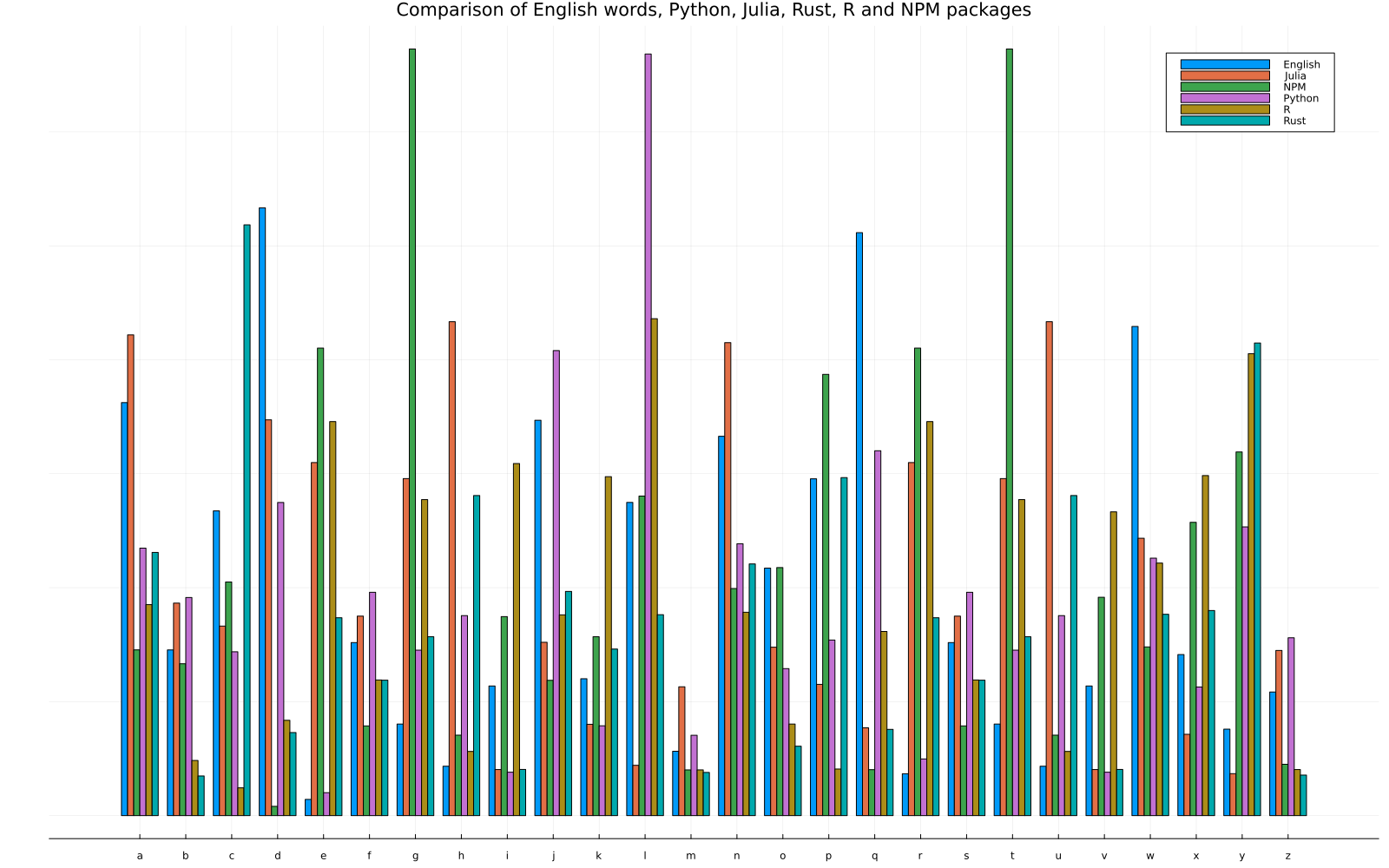 ::: ::::